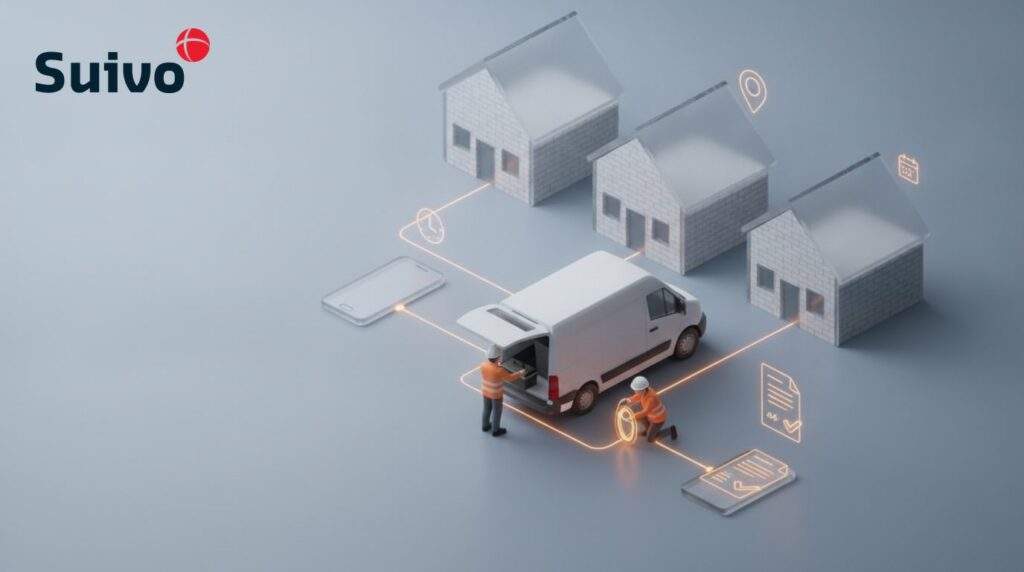


Geofencing and IoT is a winning combination when it comes to giving you peace of mind about where your assets are. But what is geofencing exactly? How does it work with IoT? And why do you need it? Let’s find out!
What is geofencing?
Geofencing literally means defining a certain geographical area, via a virtual perimeter. You can picture it as a digital fence with predefined boundaries. There are many ways to establish a geofencing area, but the most well-known is a radius around a point location.
Key takeaways
- Geofencing sets a virtual perimeter around a location, most often a radius around a point, using GPS.
- When a person with a mobile device or an asset crosses that perimeter, software can trigger alarms, notifications or actions.
- In Suivo’s IoT Cloud Platform you start a geofence from an address and then set its borders to your needs.
- Common uses are theft alerts for assets, automatic barriers, location-based safety messages, lower speed limits in risk zones and automatic attendance lists.
How does geofencing work?
Geofencing uses GPS technology to define a geographical area to ‘fence’. This is linked to software packages which can be used to set alarms, trigger notifications, take actions, etc. whenever the perimeter is crossed by a person (with mobile device) or asset.
For example, if your organization has a large site where you store a lot of expensive materials and equipment, you can set your geofence to enclose your location and receive notifications when any of your materials or equipment crosses your boundary. You can also log when people enter and leave. All of this has the benefit of safety and security for your assets and people.
Another example is if you manage all the rolling materials for your organization. You can set your geofence to send you an alarm if they leave a certain area.
The possibilities are endless.
Geofencing at Suivo
At Suivo, we use geofencing technology in different ways to track your assets and give you peace of mind. In our IoT Cloud Platform, you can quickly and easily define your digital geofences by setting an area starting with the address, then setting the borders based on your organization’s requirements.
Let’s take a look at some situations where geofencing and IoT from Suivo makes the difference:
• Receive notifications for specific assets
After establishing your geofencing boundary, you can add a rule to notify you when specific assets leave the area, helping to reduce potential theft or misplaced assets and reducing the likelihood of improper use of your assets by your employees.
• Automatically open barriers
Another rule could automatically open a barrier or gate when an asset approaches. This could be used to let in deliveries on a specific truck or type of truck, or to give automatic access to employees with a badge.
• Location based messages
It’s also possible to send an important message to all visitors and employees when they arrive in a certain geofence zone or a specific job needs to be started in your software package. For example, the message could remind visitors and employees about “No Go” areas or PPE needed for dangerous zones.
• Improved safety
Large warehouses often have a lot of internal traffic – vehicles including forklifts and trucks, as well as pedestrians – which can lead to dangerous situations. By defining an area of your warehouse, such as a crossroad, as a large risk zone, you can set a maximum (lower) speed for warehouse trucks in this zone, decreasing the risk and improving safety.
• Automatic attendance lists
Knowing which employees are on site, including the times they arrive (and later leave), is useful information for completing work timesheets and for knowing who is on site in case of an emergency. Geofencing can be set up to automatically capture this information before transferring it to your systems, reducing your administrative workload.
But it doesn’t stop here, geofencing is just one aspect of geolocation services which are growing rapidly, opening up new possibilities, new benefits, and new opportunities. The question is how can your organization use geofencing to maximize its return from a financial, safety, and security point of view?
Frequently asked questions
What is geofencing?
Geofencing defines a geographical area with a virtual perimeter, like a digital fence with predefined boundaries. The most common way to set one up is a radius around a point location. Linked software then reacts whenever a person with a mobile device or an asset crosses that boundary.
How does geofencing work with IoT?
Geofencing uses GPS to define the area, and software linked to it sets alarms, sends notifications or takes actions when the perimeter is crossed. With IoT, this works for people carrying a mobile device and for tracked assets. For example, you get an alert when expensive equipment leaves your storage site.
Can geofencing help prevent equipment theft?
Yes. Set a geofence around the site where you store materials and equipment, then add a rule that notifies you when specific assets leave the area. This helps reduce theft and misplaced assets, and lowers the chance of employees using assets improperly.
How does geofencing improve safety in a warehouse?
You can mark a busy zone, such as a crossroad shared by forklifts, trucks and pedestrians, as a high-risk area and set a lower maximum speed for warehouse trucks inside it. You can also send messages about no-go areas or required PPE when people enter a zone.
Next steps: geofencing at your location
If you’re not sure where to start or how to get the most out of geofencing, contact us. We’re happy to help you investigate how and where geofencing with IoT can make your life safer, easier, cheaper, and more automated. Contact Suivo to find out more.
Related reading
Free guide for transport & logistics
Make Every Kilometer Count
How Belgian transport and logistics firms cut idle time, fuel use and admin with fleet data.