

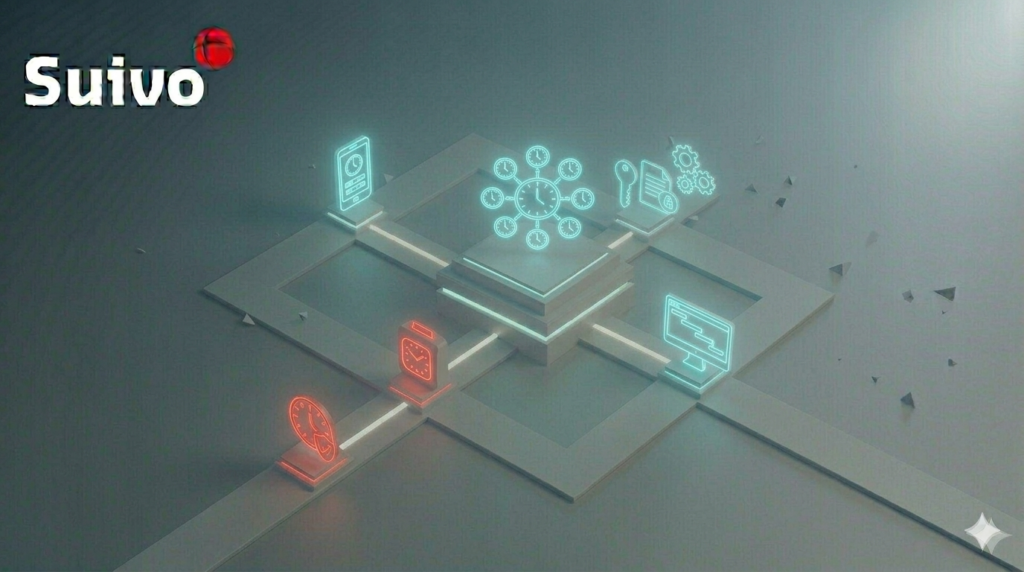
A plain-English guide to time registration systems for Belgian employers, the methods, the technology, and how to choose what fits your operation.
If you have ever asked yourself “what exactly is a time tracking system, and which type do I actually need?”, you are not alone. For most Belgian HR and operations managers the question becomes urgent the moment compliance, payroll accuracy, or a looming deadline forces the issue. A modern time tracking system is simply the combination of hardware, software, and apps that records who worked, where, and for how long, and then turns those records into reliable data for payroll, invoicing, and inspection. This guide explains the main types of time registration systems in clear language, shows where each one fits, and helps you match a method to your industry before you spend a euro.
Quick Navigation
- What a time tracking system actually is
- The main types of time registration systems
- Quick reference: which type fits which situation
- Choosing the right system for your business
- Implementation checklist
- What is changing by 2027
- Managing time registration with technology
- Frequently Asked Questions
What a Time Tracking System Actually Is
A time tracking system is a tool that captures the start and end of working time, and often breaks, locations and activities, in a way that is accurate, repeatable and verifiable. At its simplest it answers three questions: who was present, when, and where. The output feeds straight into payroll, project costing and, in Belgium, into legal obligations such as Check in at Work on construction sites.
The reason the topic matters now is regulation. From 1 January 2027 the government intends to require every Belgian employer to keep an objective, reliable daily record of working hours, following the transposition of the EU Court of Justice CCOO ruling. You can read the original judgment on EUR-Lex. That single change moves time registration from “nice to have” to “required” for organisations that previously relied on paper or memory.
A useful way to think about it: a time tracking system has three layers, a capture point (how the worker registers), a transmission layer (how the data reaches the server), and a management layer (where you review, correct and export). Suivo’s capture happens in real time over WiFi or mobile data, which means every registration is verified at the moment it happens. There is no local editing and no backdating, so the timestamp you see is the timestamp an inspector sees.
The Main Types of Time Registration Systems
There is no single “best” system, there is the system that matches your workforce, your sites and your integrations. Below are the four families you will encounter, with the situations they suit.
Mobile App Registration
- Workers clock in and out on a smartphone, with optional GPS confirmation of location.
- Ideal for mobile teams: construction crews, installers, cleaners moving between sites.
- Fast to deploy, no fixed hardware needed at every location.
- Requires an active connection at the moment of registration, which is exactly what makes the record tamper-resistant.
Fixed Terminal or Badge Reader
- A wall-mounted reader at the entrance; workers tap a badge or card.
- Best for single-location operations with a clear entry point, a concrete plant office, a meat-processing facility, a depot.
- Durable and simple for staff who do not carry company phones.
- Official guidance on attendance obligations is published by the Belgian social security service at socialsecurity.belgium.be.
Biometric Registration
- Fingerprint or facial recognition removes the risk of “buddy punching” (one worker clocking in for another).
- Powerful for accuracy, but biometric data is sensitive personal data under GDPR.
- In Belgium, biometric time tracking requires a strong justification and a data protection impact assessment; the Belgian DPA explains the rules at gegevensbeschermingsautoriteit.be.
Vehicle and Asset-Linked Registration
- Time is captured through the vehicle or equipment a worker uses, via vehicle tracking or connected assets.
- Suited to transport, utility and field-service teams whose “workplace” is the road or a rotating set of sites.
- Pairs naturally with asset management so labour and equipment data live in one platform.
Quick Reference: Which Type Fits Which Situation
| System type | Best for | Setup effort | Compliance strength | Verdict |
| Mobile app | Mobile crews, multi-site teams | Low (no fixed hardware) | High, real-time, tamper-resistant | ✅ Recommended for field operations |
| Fixed terminal / badge | Single-location sites | Medium (install readers) | High at a fixed door | ✅ Recommended for one entry point |
| Biometric | High buddy-punching risk | Medium-High (DPIA needed) | High accuracy, GDPR-sensitive | ⚠️ Only with legal justification |
| Vehicle / asset-linked | Transport, field service | Medium (in-vehicle units) | High for road-based work | ✅ Recommended for fleets |
Compliance strength assumes registrations are transmitted in real time. Suivo registrations require an active WiFi or mobile data connection, which guarantees the timestamp cannot be altered after capture.
Choosing the Right System for Your Business
- Map your workforce: Are people fixed at one site or moving between many? Mobile teams point toward app-based time tracking; single sites point toward a terminal.
- Check your legal triggers: If you work in construction, the Check in at Work thresholds may already make electronic attendance mandatory.
- Confirm payroll integration: A good system exports straight to Belgian payroll providers (SD Worx, Partena, Acerta). Compare options in our overview of the best digital time registration tools.
- Match your budget to scope: Per-user pricing scales with team size, see current pricing before committing.
| ⚠️ Regulatory warning: In the construction sector, electronic Check in at Work registration is mandatory once subcontractor thresholds are crossed (no subcontractor above €500,000; one subcontractor above €5,000; two or more subcontractors always). Fines run from €300 administrative up to €6,000 per worker per day for criminal violations. A time tracking system that cannot prove its timestamps will not protect you in an inspection. |
Implementation Checklist
- Define which sites and roles need registration.
- Decide the capture method per group (app, terminal, vehicle).
- Confirm connectivity at each location, Suivo needs a live signal to register.
- Use time tracking to set break rules and rounding policies before go-live.
- Run a two-week pilot with one team and review the exports.
- Brief workers on GDPR: what is collected, why, and how long it is kept.
What Is Changing by 2027
- From 1 January 2027 an objective daily working-hours record is planned to become mandatory for all Belgian employers.
- Sector expansions of Check in and Out (CIAO), already active in cleaning since 1 September 2024, are likely to widen.
- Payroll and ERP integrations are becoming the deciding factor, not a bonus.
- Expect tighter GDPR scrutiny of location and biometric data; plan your time tracking policy now rather than retrofitting later.
Managing Time Registration with Technology
Once you understand the types, the practical question is which platform ties them together. Suivo, a Belgian time registration company with over 15 years of experience, offers comprehensive time tracking for companies navigating Belgian compliance. Their platform helps you:
- Capture time by app, terminal or vehicle from a single platform.
- Meet Check in at Work and Check in and Out obligations automatically.
- Verify every registration in real time, so timestamps are inspector-ready.
- Export directly to SD Worx, Partena and Acerta payroll.
- Connect labour data to asset management and vehicle tracking.
- Support staff in Dutch, French and English from a local team.
- Compare your options against the market in our tools guide.
Suivo’s IoT platform integrates seamlessly with existing payroll and ERP systems, helping companies like Hoogmartens and Cegelec keep accurate, audit-proof records across dozens of sites.
“We used to chase paper timesheets every Friday. With a single app-based system, the data is already correct and already exported by the time payroll runs.”
– HR Manager, mid-size construction firm near Hasselt
Take Action Today
Don’t let the 2027 mandate catch your team unprepared. Start by mapping where your people actually work, decide on a capture method per group, and consider implementing a comprehensive time tracking system that proves its own timestamps.
For more information about time registration systems, contact Suivo at +32 3 375 70 30 or visit their time tracking solution page to discover how their smart solutions can help your business register hours accurately and stay compliant. You can also book a demo.
Free Time Registration Checklist
Want to choose a time tracking system with more confidence? Our Checklist gives you a simple, practical overview to plan smarter, stay compliant, and keep full real-time insight across your operations.
Inside, you’ll find:
- The biggest challenges in time registration today
- How Suivo helps with compliance, payroll accuracy, and real-time visibility
- Real-life success stories from Hoogmartens, Cegelec, and Van Moer
- Practical solutions for fleet, workforce, and asset management
Frequently Asked Questions
What is the simplest type of time tracking system?
For most mobile teams, an app-based system is the simplest, there is no fixed hardware to install and workers register on a phone. You can see how it works on the time tracking page.
Is a time tracking system mandatory in Belgium?
From 1 January 2027 an objective daily working-hours record is planned to become mandatory for all employers, and construction already faces Check in at Work obligations today.
Can one system handle both office and site staff?
Yes. A platform like Suivo lets you mix capture methods, a terminal at the office, an app for crews, within one set of records and one export.
Does Suivo work without an internet connection?
No. Registrations require an active WiFi or mobile data connection at the moment they are made. This is deliberate: it guarantees data integrity and means timestamps cannot be backdated or altered. For poor-signal locations, options include fixed readers with their own connectivity or vehicle-based registration.
How does a time tracking system connect to payroll?
Good systems export validated hours straight to providers like SD Worx, Partena and Acerta. Our tools comparison shows which integrations to look for.
Related reading
Free guide for construction
Get Ahead in Construction
A practical guide to digitising site registration, hours and equipment, written for Belgian contractors.
Download the guideSee workforce solutions →